

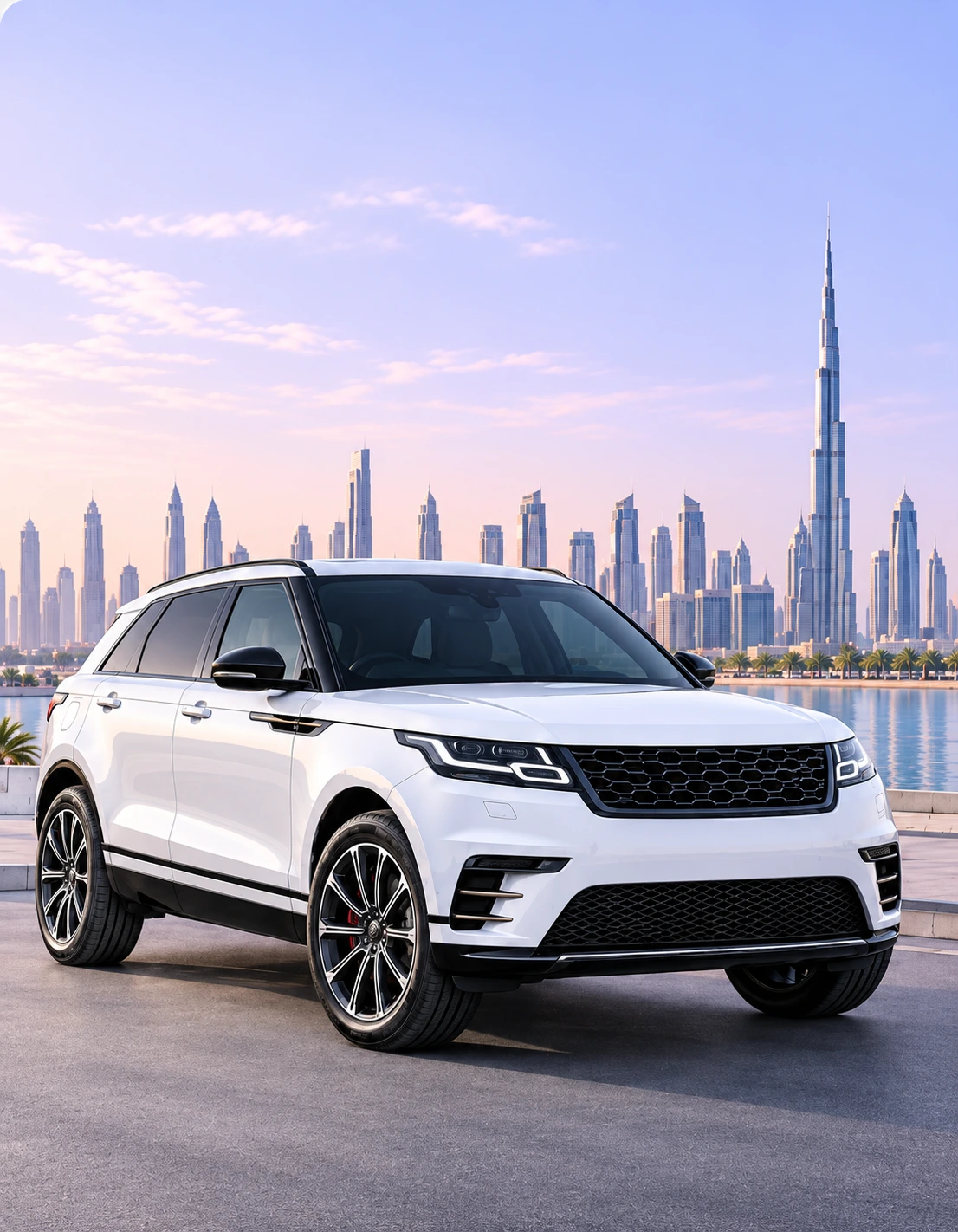


Drive on the right, carry a valid licence, follow posted speed limits, wear seatbelts in every seat, don't use a handheld phone and give way to pedestrians and emergency vehicles.
UAE Traffic Rules for Drivers: The Complete Rental-Car Driver's Handbook
24/7 Support
Always here when you need help
Free Delivery
Delivered at your preferred location
Best Rates
Competitive pricing for every trip
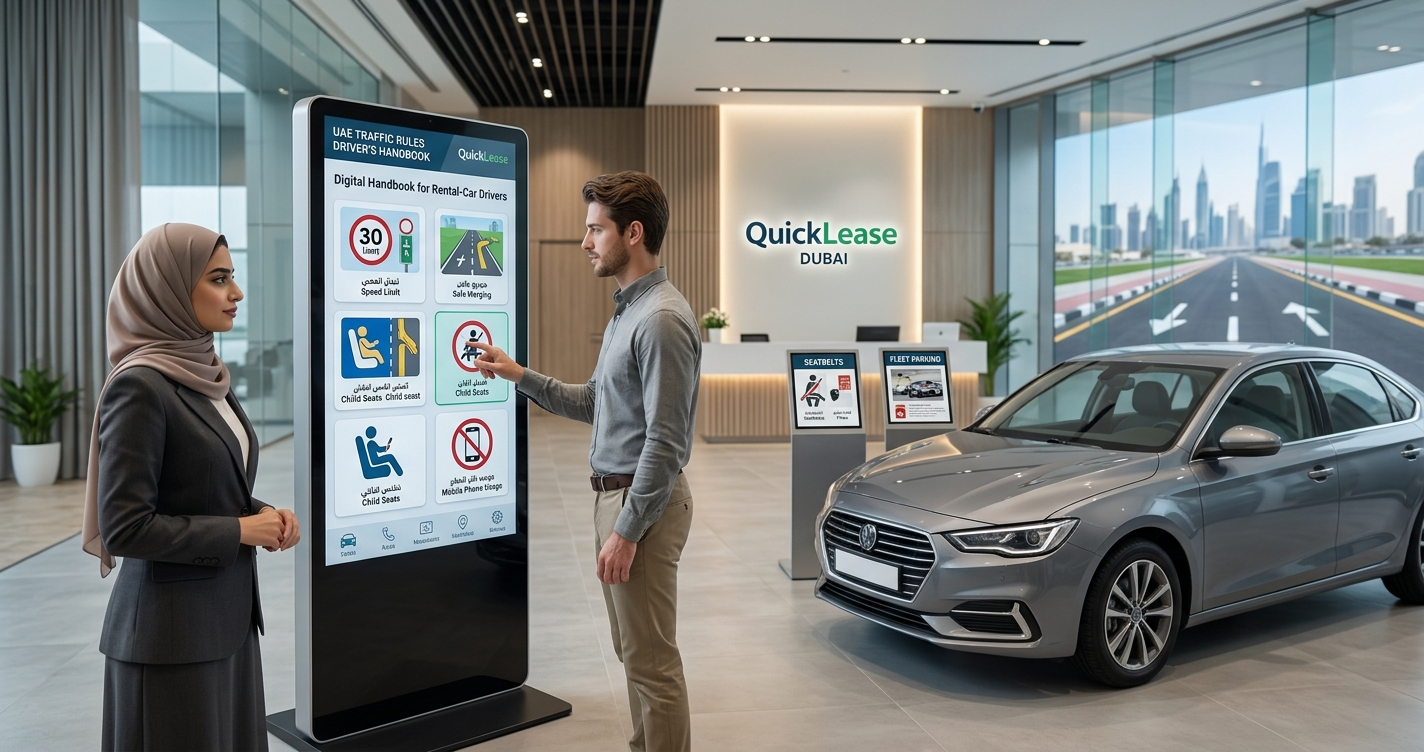
Quick answer: UAE traffic rules for drivers are set by federal law and enforced by police in each emirate. The essentials: drive on the right, carry a valid licence (home licence or IDP for many visitors, UAE licence for residents), follow posted limits (Dubai allows a 20 km/h radar buffer, Abu Dhabi none), wear seatbelts in every seat, never use a handheld phone, and avoid black points: 24 in 12 months suspends your licence.
The UAE has some of the best roads in the world. It also has strict, camera-enforced rules, fines that can reach thousands of dirhams and a points system that can take your licence away.
Most of the drivers we serve at Quick Lease are new to driving here, visiting, or simply unsure which rules have changed. This handbook brings everything together in one place. Each section gives you the essentials and links to a detailed guide where you need more.
If you're about to collect a car, our car rental Dubai team can walk you through the basics at handover, but it pays to read this first.
Who this handbook is for
- Visitors and tourists driving a rental car on a home licence or International Driving Permit.
- New residents in the gap between arrival and getting a UAE licence.
- Long-term residents who want a refresher on rules that have changed in recent years.
- Business travellers driving between emirates for meetings.
Rules apply to everyone equally. A rental car doesn't change your responsibilities; it just adds a rental company between you and the fine.
The basics of driving in the UAE
The UAE drives on the right, with the steering wheel on the left. Overtake on the left. Most rental cars are automatic.
Distances are in kilometres and speeds in km/h. Road signs are in Arabic and English. Highways use E-numbers: E11 (Sheikh Zayed Road through Dubai and on to Abu Dhabi), E311 (Sheikh Mohammed bin Zayed Road), E611 (Emirates Road), E44 (towards Hatta) and E66 (towards Al Ain).
Seven emirates, one federal traffic law, but local differences in enforcement, tolls and parking. We cover those differences further down.
Road signs and electronic message boards
UAE road signs follow international conventions, with text in Arabic and English. Blue signs give directions, brown signs point to tourist attractions, and red-bordered signs give orders or warnings.
Pay special attention to electronic variable message signs (VMS) on highways. They show reduced speed limits during fog, rain, sand or incidents, lane closures ahead and accident warnings. A limit shown on an electronic sign overrides the fixed sign beside the road, and radars follow the electronic limit.
Exit numbers on major highways are a useful backup when street names are unfamiliar. Many locals give directions by exit number or interchange rather than road name.
Driving licences: who can drive on what
Your licence depends on your status.
Visitors from many countries, including most of Europe, the GCC, the US, the UK, Canada and Australia, can drive a rental on their home licence. Visitors from other countries typically need an International Driving Permit alongside their licence. Our existing guide on renting a car in Dubai as a tourist lists rules by country.
Residents must hold a UAE licence once their residence visa is issued. Holders of licences from countries on the RTA's eligible list can convert without a full test; others go through training and testing. A dedicated guide to licence conversion countries publishes in November.
Age: You must be at least 18 to drive a car in the UAE, but most rental companies require drivers to be 21 or older, sometimes 25 for premium cars.
Speed limits and the speed buffer
Speed limits are clearly posted. Typical limits are 40–60 km/h in residential areas, 60–80 km/h on city roads and 100–140 km/h on highways.
Dubai and most emirates apply a 20 km/h radar buffer, so cameras generally flash above the posted limit plus 20. Abu Dhabi removed its buffer in 2018: the posted limit is the radar limit. Electronic signs can lower limits during fog, rain or incidents, and the new limit applies immediately.
Speeding fines start at AED 300 and rise to AED 3,000, with black points and impoundment above 60 km/h over the limit. For the full breakdown, read our guide to the Dubai speed limit buffer.
The black points system
Black points are penalty points added to your traffic file for serious offences. Reach 24 within 12 months and your licence is suspended: three months the first time, six months the second, a year the third.
Some everyday offences carry 4 points each, including using a phone while driving, tailgating and not wearing a seatbelt. Running a red light carries 12. Each point expires 12 months after the offence.
Points from rental cars are applied to the driver, not the rental company. Our full guide to black points in the UAE explains how to check and reduce them.
Seatbelts and child safety
Seatbelts are mandatory for every occupant, front and back. The driver can be fined if passengers aren't belted.
Children under four must be in a suitable child seat. Children under 10, or shorter than 145 cm, shouldn't sit in the front seat. If you're renting, request child seats when you book; availability is limited in peak season.
Mobile phones and distractions
Holding a phone while driving is fined, commonly AED 800 with 4 black points. That includes texting, calling without hands-free, and filming or taking photos. Taking or sharing photos of accident scenes is also an offence.
Set your navigation before you move. Use a phone holder and voice commands.
Lane discipline, overtaking and tailgating
Stay in the right-hand lanes unless overtaking. The far-left lane is for faster traffic and overtaking, not cruising.
Common lane offences include:
- Tailgating. Not keeping a safe distance is fined and carries black points.
- Sudden swerving. Cutting across lanes without warning is heavily fined.
- Overtaking from the hard shoulder. Illegal and dangerous.
- Failing to indicate. Always signal lane changes.
Leave at least a two-second gap in good conditions, and more at speed or in poor weather.
Indicators, the horn and headlights
Indicate every time you change lanes, turn or leave a roundabout. Changing lanes without indicating is a common fine, and it's one of the main causes of side-swipe collisions on Sheikh Zayed Road.
Use the horn only to warn of danger. Persistent honking is considered rude and can draw attention from police.
Headlights must be on from sunset to sunrise and in poor visibility. Flashing headlights at the car in front to make it move aside is common on UAE highways, but tailgating while you do it is an offence. If someone flashes behind you in the left lane, move right when safe.
Junctions, roundabouts and traffic lights
At roundabouts, give way to traffic already on the roundabout. Choose your lane early based on your exit.
Red light cameras are everywhere. Running a red light costs AED 1,000, 12 black points and vehicle impoundment. Amber means stop if you safely can, not speed up.
Pedestrians and emergency vehicles
Give way to pedestrians at marked crossings. Failing to do so is fined and carries black points.
When an ambulance, police car or fire engine approaches with lights and sirens, move aside safely and let it pass. Blocking emergency vehicles carries heavy fines, black points and possible impoundment. Never follow an emergency vehicle closely to get through traffic.
Motorcycles, delivery riders, cyclists and e-scooters
Delivery motorcycles are everywhere in Dubai, especially in the evenings. Check mirrors and blind spots before every lane change and turn. Dubai has restricted delivery riders from the fastest lanes on multi-lane roads, but expect them to filter through slow traffic.
Cyclists use dedicated tracks such as Al Qudra and parts of Jumeirah, but you'll also meet them on community roads and, at weekends, on routes like Jebel Jais. Give at least 1.5 metres when passing.
E-scooters are permitted in designated areas and tracks under RTA rules. Watch for them near Metro stations and in residential districts, particularly at night.
Heavy vehicles and truck restrictions
Trucks and heavy vehicles face peak-hour restrictions on many major Dubai roads, but you'll still share highways like Emirates Road and the E11 towards Jebel Ali with them. Avoid lingering in a truck's blind spot, don't cut in sharply in front of one, and leave extra space when following. Trucks need much longer distances to stop.
Drinking and driving
The UAE has zero tolerance for drink-driving. Any alcohol in your blood while driving is an offence and can lead to arrest, a court case, heavy fines, licence suspension and, for residents, serious consequences for residency. Rental insurance won't cover any incident involving alcohol.
Driving in fog, rain and sandstorms
Winter brings morning fog; occasional storms bring heavy rain and flooding; spring brings dust and sand.
In fog, use low beams and fog lights, slow down and increase your gap. Never use hazard lights while moving: that's fined AED 500 with 4 black points. Abu Dhabi cuts limits to 80 km/h on affected roads. Our guide to driving in fog in the UAE covers the rules step by step.
In heavy rain, slow down and avoid flooded underpasses. Entering a flowing wadi is fined AED 2,000 with 23 black points and impoundment.
Breakdowns and the hard shoulder
If your car breaks down, move onto the hard shoulder or a safe area as far from traffic as possible. Switch on hazard lights (correct here, because you're stationary), and get passengers out of the car and behind the barrier if it's safe to do so.
Then call your rental company's roadside assistance number. Don't attempt repairs beside fast-moving traffic. Driving on the hard shoulder to skip queues is illegal and heavily fined.
Driving during Ramadan
Ramadan changes the rhythm of the roads. Traffic peaks sharply in the hour before iftar as people hurry home, and roads are unusually quiet just after sunset. Be patient, leave extra time and avoid aggressive driving in the late afternoon.
Salik, parking and Darb timings change during the holy month. Check the operators' Ramadan schedules each year. Out of respect, avoid eating, drinking or smoking while driving during fasting hours.
What to do if you have an accident
For minor accidents with no injuries, move the cars out of traffic if they can be driven, and report through the Dubai Police app or call 999 elsewhere. For any injuries, call 999 immediately and don't move vehicles.
Rental insurance claims require a police report. Notify your rental company straight away. A step-by-step guide to minor accidents in rental cars publishes on 23 October.
Tolls and parking
Dubai (Salik): AED 6 per gate at weekday peaks and AED 4 off-peak, free from 1am to 6am, plus 5% VAT since June 2026. Rental cars come with tags.
Abu Dhabi (Darb): AED 4 per crossing at bridge gates during peaks (7–9am, 3–7pm, Monday to Saturday), plus two gates at Ghantoot and Al Qurm that charge at all hours.
Parking: Dubai's paid parking runs 8am–10pm, Monday to Saturday, with premium and standard rates. Our guide to Dubai parking zones decodes the signs.
Key differences between Dubai and Abu Dhabi
| Rule | Dubai | Abu Dhabi |
|---|---|---|
| Speed buffer | Generally 20 km/h | None |
| Toll system | Salik (variable pricing) | Darb (peak hours at bridges; two 24/7 gates) |
| Weather speed limits | Variable signs | 80 km/h during fog, rain, dust |
| Paid parking operator | Parkin | Mawaqif (Q Mobility) |
| Minor accident reporting | Dubai Police app | Abu Dhabi Police / Saaed services |
The northern emirates (Sharjah, Ajman, Umm Al Quwain, Ras Al Khaimah, Fujairah) generally follow federal rules with the 20 km/h buffer, but always follow the signs.
Rules that matter specifically for rental cars
- Fines go to the rental company first and are passed on to you, usually with an admin fee.
- Only named drivers are insured. Add every driver to the agreement.
- No off-road driving unless the agreement allows it.
- No driving into Oman without written permission and Oman insurance.
- Return the car on time. Late returns can be charged as an extra day.
- Report damage immediately, with a police report.
How to check and pay traffic fines
Use the Dubai Police app, the RTA app, the MOI UAE app or the Abu Dhabi Police app. Search by plate, licence or traffic file number. Rental car fines usually reach you through the rental company, but residents can also see violations transferred to their own traffic file.
Some emirates offer discounts for early payment. Abu Dhabi, for example, has offered reduced fines for payment within set periods, and police in several emirates run periodic discount campaigns. Dubai Police has also offered instalment options for larger fines through partner banks. Discounts reduce the money owed, not the black points.
Don't ignore fines. Unpaid fines can block vehicle registration renewals and licence services, and visitors may be asked to settle outstanding rental fines before or after departure through the rental company.
Parking rules beyond paying the meter
Paying for parking isn't the only rule. Don't park where kerbs are painted with restriction markings, in front of fire hydrants, on pavements, or across building entrances and driveways. Spaces for people of determination require a valid permit, and misuse carries a large fine and black points.
Double-parking "for one minute" outside a shop is one of the most common fines in older areas like Deira, Karama and Bur Dubai. So is stopping on a highway to take photos, which is both fined and dangerous.
Driving to Oman
Oman borders the UAE at several points, including near Hatta, Al Ain, Dibba and Ras Al Khaimah. A rental car can only cross into Oman with the rental company's written permission and valid Oman insurance. Crossing without both leaves you uninsured. Check visa requirements and border fees before planning a cross-border trip.
A quick checklist before your first drive
- Check your licence is valid for your status (visitor or resident).
- Adjust seat, mirrors and set up navigation before moving.
- Find the headlight, fog light and hazard switches.
- Install the Salik and Parkin apps if you'll drive often.
- Save the rental company's breakdown and accident numbers.
- Know the speed limits on your route, and that Abu Dhabi has no buffer.
Key takeaways
- Federal law sets the rules; each emirate enforces them, with local differences.
- Visitors may drive on home licences or IDPs; residents need a UAE licence.
- Dubai has a 20 km/h radar buffer; Abu Dhabi has none.
- 24 black points in 12 months suspends your licence.
- Rental car fines and points still land on you as the driver.
Sources: UAE Federal Traffic Law and Ministry of Interior violation schedules; Dubai RTA; Dubai Police; Abu Dhabi Police; Salik PJSC; Parkin PJSC; Abu Dhabi Integrated Transport Centre. Rules change: verify figures in the week of publishing. Last updated: 17 October 2026.


FAQ
Frequently Asked Questions
Frequently asked questions about this article.

Need more help?
Contact us