



Public AC charging costs AED 0.70 per kWh and DC fast charging AED 1.20 per kWh, both plus 5% VAT, under the UAE's unified tariff.
Where to Charge an EV in Dubai: DEWA EV Green Charger Network Explained
24/7 Support
Always here when you need help
Free Delivery
Delivered at your preferred location
Best Rates
Competitive pricing for every trip
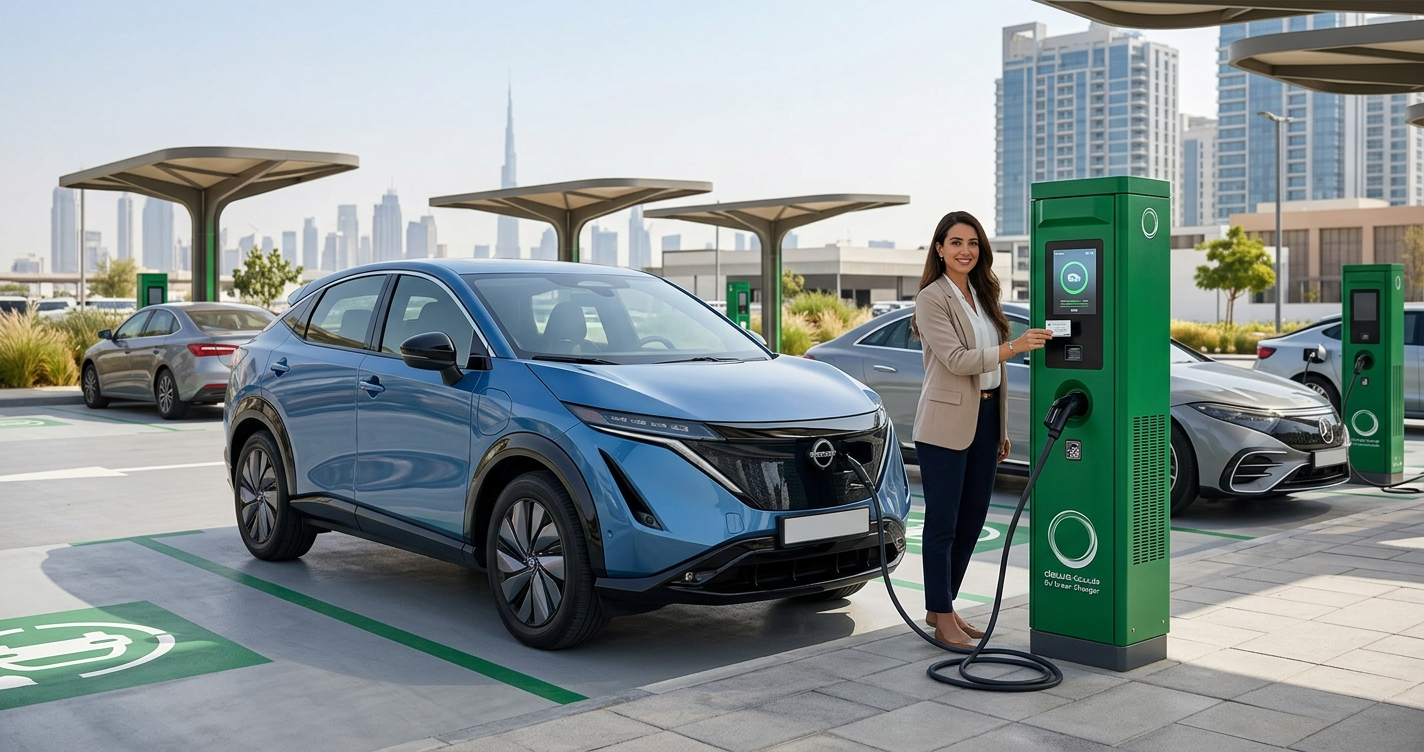
Quick answer: Dubai's main public EV charging network is DEWA's EV Green Charger, with more than 1,860 charging points by early 2026. Under the UAE's unified tariff, public AC charging costs AED 0.70 per kWh and DC fast charging AED 1.20 per kWh, both plus 5% VAT. Visitors and rental drivers can charge in Guest Mode by scanning the QR code on the charger.
Your rental EV shows 18% battery. You're in Al Barsha. Dinner's in Jumeirah in an hour. Where do you plug in?
In Dubai, the answer is usually closer than you think. DEWA's Green Charger network has grown fast, from 14 stations in 2015 to more than 1,860 charging points by early 2026, according to DEWA's own reporting.
Thinking about going electric on your next rental? Our electric car rental UAE guide covers which EVs and hybrids make sense here. This article is about the practical bit: charging.
What is the DEWA EV Green Charger network?
EV Green Charger is the public charging programme run by the Dubai Electricity and Water Authority (DEWA). It launched in 2014 as the region's first public EV charging network.
Chargers sit at malls, petrol stations, government buildings, hotels, residential communities and DEWA offices. You'll find them in most busy districts, including Downtown, Dubai Marina, Al Barsha, Deira, Dubai Silicon Oasis and along Sheikh Zayed Road.
How much does public EV charging cost in Dubai?
Free public charging for non-commercial users ended some time ago. Since the UAE introduced a unified public charging tariff (Cabinet Resolution No. 81 of 2024), public chargers across operators follow the same base rates.
| Charger type | Base rate | With 5% VAT | Rough cost to add 200 km* |
|---|---|---|---|
| AC (Level 2) | AED 0.70/kWh | AED 0.735/kWh | ~AED 25–30 |
| DC fast / ultra-fast | AED 1.20/kWh | AED 1.26/kWh | ~AED 45–50 |
*Assumes an efficient compact EV using about 17–19 kWh per 100 km. Larger SUVs use more.
How does that compare with petrol? With Special 95 at AED 3.69 a litre in September 2026, a petrol car using 7 L/100 km spends around AED 52 to cover 200 km. AC charging is roughly half that. DC fast charging lands close to petrol, so it's the convenience option rather than the savings option.
Registered users vs Guest Mode
Registered users (usually EV owners) apply for a Green Charger card through DEWA. Charging is billed to their DEWA account.
Guest Mode is for everyone else, including tourists and rental drivers. You scan the QR code on the charger, choose a charging package or amount, and pay by card or Apple Pay. No account needed.
If you're renting an EV, Guest Mode is almost always the way to go. Ask whether your rental car comes with a charging card already linked to the rental company's account. Some do.
Charging tips for rental EV drivers
Plan charging around your day, not your battery level. Plug in when you stop for lunch or shopping rather than waiting until you're at 10%.
For trips outside Dubai, check your route on the UAEV app first. Abu Dhabi, Sharjah and the northern emirates have growing networks, but mountain routes like Jebel Jais use more energy on the climb.
Prefer a car you never have to plug in? A self-charging hybrid gives you much of the fuel saving without charging stops. We compare running costs in our guide to BYD hybrid vs petrol crossovers (publishing 18 October). If you want to try an electrified car, you can rent BYD Dubai models through Quick Lease.
Before you collect any EV, it's worth running through our list of questions to ask before you book a car rental in Dubai, and adding two of your own: which charging cable is in the boot, and what battery level the car must be returned at.
AC, DC or ultra-fast: which charger should you use?
- AC chargers are the most common. They're best when you'll be parked for a few hours, at a mall, a hotel or the office. Expect a meaningful top-up over 2–4 hours, depending on the car.
- DC fast chargers are mostly at petrol stations and busy hubs. Many EVs reach around 80% in 30–45 minutes.
- Ultra-fast chargers (150 kW and above) cut that further on cars that support high charging speeds.
One thing renters overlook: not every EV can use every charger at full speed. Check the car's maximum DC charging rate and connector type (most cars in the UAE use CCS2 for DC and Type 2 for AC).
How to find a charger
- Open the DEWA app or DubaiNow and search for EV Green Charger stations.
- Use the UAEV app for chargers on the federal network, especially outside Dubai.
- Check Tesla Superchargers if you're driving a Tesla. Some sites are open to other brands.
- Look at your car's built-in navigation, which often shows nearby chargers and live availability.
Before you drive to a charger, check it's showing as available. Popular mall chargers fill up on weekend evenings.
Charging etiquette in Dubai
Move your car once it's charged. Many malls and communities reserve EV bays for charging only, and parking without charging can be fined in some locations.
Don't unplug someone else's car, even if it looks full. And if you're using an AC bay at a mall, don't leave your car plugged in all day. Others are waiting.
Key takeaways
- DEWA's EV Green Charger network had more than 1,860 charging points by early 2026.
- Public charging costs AED 0.70/kWh (AC) and AED 1.20/kWh (DC), plus 5% VAT.
- Rental drivers can use Guest Mode by scanning the charger's QR code.
- AC charging costs roughly half as much as petrol per km; DC fast charging is close to petrol.
Sources: DEWA (EV Green Charger network figures, 2026), UAE Cabinet Resolution No. 81 of 2024 (unified EV charging tariff), UAE Fuel Price Committee (September 2026). Last updated: 7 October 2026.


FAQ
Frequently Asked Questions
Frequently asked questions about this article.

Need more help?
Contact us