



The Hiace is better for bulky, heavy or high-volume loads. The LiteAce is better for light parcels and city last-mile delivery.
Renting Vans for Delivery Businesses in Dubai: Hiace vs LiteAce
24/7 Support
Always here when you need help
Free Delivery
Delivered at your preferred location
Best Rates
Competitive pricing for every trip
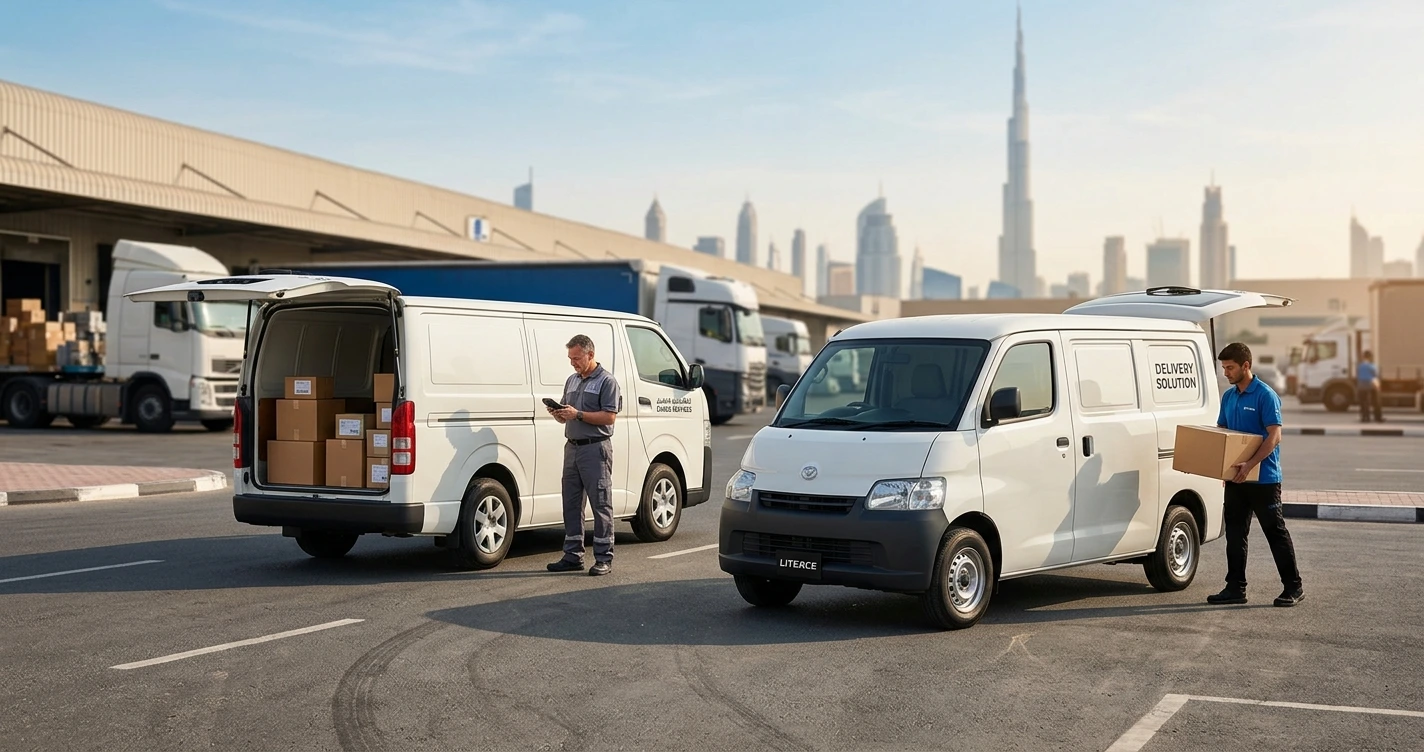
Quick answer: For delivery van rental in Dubai, choose the Toyota Hiace for bulky or heavy loads, multi-drop routes with lots of stock and furniture or catering work. Choose the Toyota LiteAce for lighter parcels, tight city streets and lower running costs. The Hiace carries much more; the LiteAce is cheaper to run and easier to park in Deira and Karama.
Every delivery business in Dubai hits the same fork in the road. Do you go big and carry everything in one run, or go small and nimble?
For most, that fork is labelled Hiace and LiteAce.
Both are Toyotas. Both are common across UAE fleets. They do very different jobs. If you're building out a delivery operation, our business vehicle leasing in Dubai team can structure a lease around either, or both.
The verdict first
- Choose the Hiace if you deliver bulky items (furniture, appliances, catering equipment), carry a full day's stock in one load, or need standing room in the cargo area.
- Choose the LiteAce if you deliver parcels, documents, pharmacy orders or small retail goods, mostly within the city.
- Choose both if you run mixed routes. Many fleets use Hiaces for hub runs and LiteAces for last-mile drops.
Hiace vs LiteAce at a glance
Specifications vary by model year, engine and roof height. Figures below are approximate for UAE-market panel vans.
| Feature | Toyota Hiace (panel van) | Toyota LiteAce (panel van) |
|---|---|---|
| Engine | Larger petrol or diesel options | Small petrol, around 1.5L |
| Approx. payload | ~1,000–1,300 kg | ~700–1,000 kg |
| Cargo volume | Large; high-roof options available | Compact |
| Turning circle | Wider | Tight |
| Typical fuel use | ~11–14 L/100 km | ~7–9 L/100 km |
| Best for | Bulk, heavy and multi-drop loads | Light, city last-mile delivery |
Cargo space: the deciding factor
Here's a simple test. Take your biggest regular delivery and your typical daily load. If either doesn't fit comfortably in a LiteAce with room to sort parcels, you need a Hiace.
Catering and events companies nearly always choose the Hiace. Chafing dishes, tables and drinks crates take up space fast. Pharmacies, e-commerce boutiques and document couriers usually find the LiteAce plenty.
Rent, lease or both?
Most delivery businesses use a mix:
- Lease your core vans for 12–36 months for the lowest monthly cost.
- Rent extra vans short-term for Ramadan, White Friday, DSF and other peaks.
- Test a new route with a rental before committing to another lease.
Browse our business vehicle rentals for short-term vans and pickups. For a step-by-step method to size your fleet, read our guide to fleet leasing for small businesses in Dubai.
Running costs
Fuel is where the LiteAce earns its keep. With Special 95 petrol at AED 3.69 a litre (September 2026), and diesel at AED 4.30:
| Monthly distance | Hiace (approx. 12 L/100 km petrol) | LiteAce (approx. 8 L/100 km) | Monthly difference |
|---|---|---|---|
| 2,000 km | ~AED 886 | ~AED 590 | ~AED 296 |
| 3,000 km | ~AED 1,328 | ~AED 886 | ~AED 442 |
| 4,000 km | ~AED 1,771 | ~AED 1,181 | ~AED 590 |
Over a year, at 3,000 km a month, that's more than AED 5,000 per van in fuel alone. Multiply by a fleet and it matters.
Parking and access in Dubai
Delivery drivers spend a surprising share of their day looking for somewhere to stop. Old Dubai neighbourhoods like Deira, Bur Dubai, Karama and Satwa have narrow streets and tight loading spots.
The LiteAce's smaller footprint makes those stops quicker. The Hiace is fine in business districts with loading bays, industrial zones like Al Quoz and Ras Al Khor, and villa communities with wide roads.
Remember that illegal stopping and double-parking are fined, and blocking traffic during deliveries is a common offence. Plan routes with loading zones in mind.
Licence and rules
Both vans can be driven on a standard UAE light vehicle licence, as they fall under the light vehicle weight category. Drivers must still follow loading rules: don't exceed the rated payload, secure cargo properly and keep the load from blocking rear visibility.
Loading and safety tips for delivery vans
- Load heavy items low and forward, close to the bulkhead, to keep the van stable under braking.
- Secure everything. Use straps, nets or shelving. Loose stock shifts in sharp turns and can damage goods or injure the driver.
- Respect the payload limit. Overloaded vans brake poorly, wear tyres faster and can be fined.
- Keep rear visibility clear where possible, and use mirrors and reversing cameras at every stop.
- Plan for heat. Vans get extremely hot inside in summer. Protect temperature-sensitive goods and keep drivers hydrated.
- Park legally at drops. Hazard lights don't make double-parking legal.
Questions to ask before you rent a delivery van
- What's the exact payload and cargo volume of the van I'll get?
- Is there a shelving or racking option?
- What's the mileage allowance and excess rate?
- How fast is a replacement van provided during repairs?
- Is branding (vinyl wrap) allowed on leased vans?
Key takeaways
- The Hiace carries much more and suits bulky or heavy deliveries.
- The LiteAce costs roughly a third less to fuel and is easier to park in older areas.
- Many fleets combine Hiaces for hub runs and LiteAces for last-mile.
- Lease your base fleet and rent for seasonal peaks.
Sources: Toyota Middle East published specifications (approximate; vary by year and variant); UAE Fuel Price Committee (September 2026). Last updated: 13 October 2026.
FAQ
Frequently Asked Questions
Frequently asked questions about this article.

Need more help?
Contact us